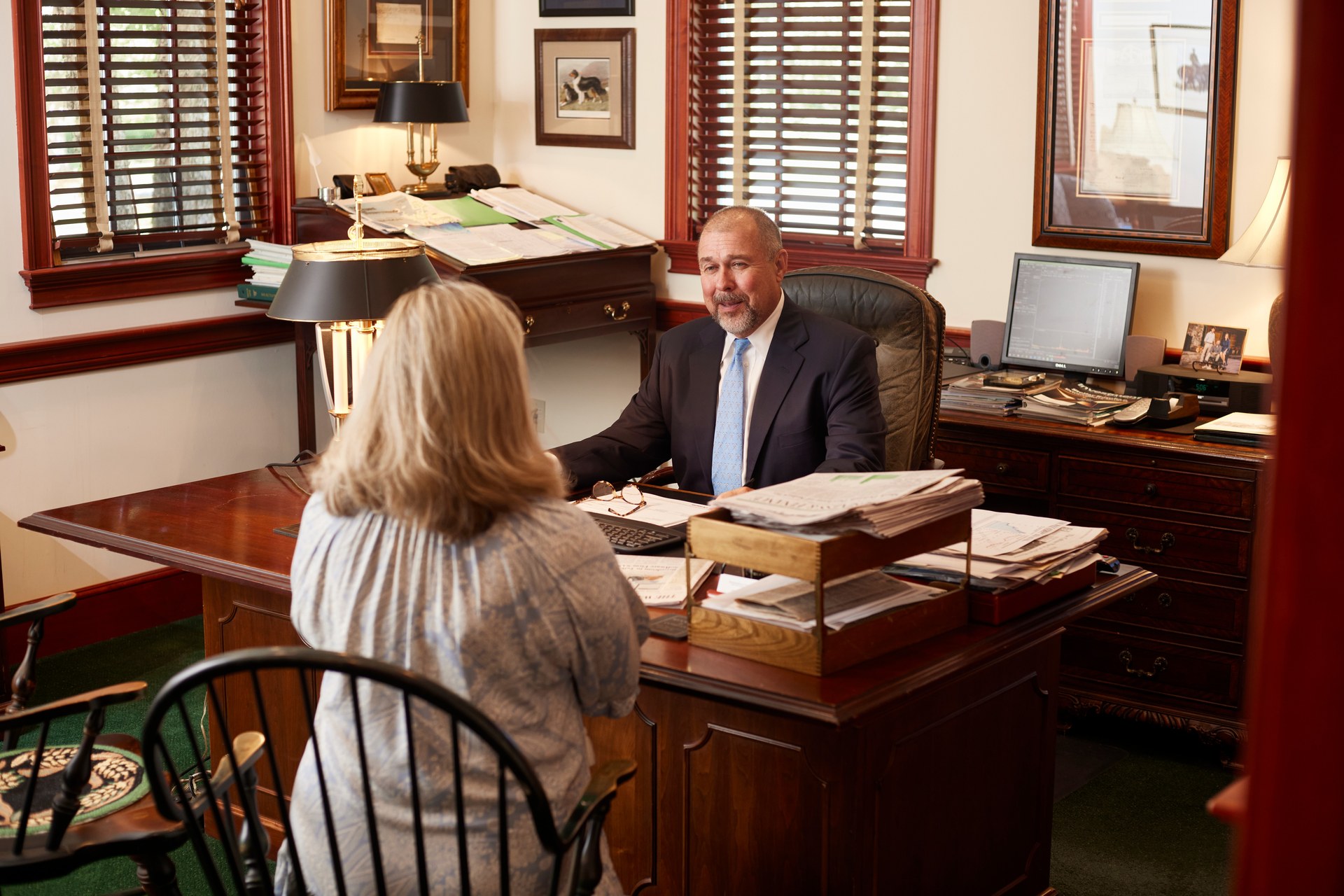
Financial planning is how the portfolio meets the life. Whether you are planning for a second home when the children move out, a tax-efficient retirement, or the smooth transfer of wealth across generations, we treat it as an integrated discipline, complimentary to our investment clients.
A portfolio only has meaning in relation to a life. Planning is how we bring the two together.
Financial planning, at Woodard & Company, is not a separate product. It is a complimentary service offered to every investment client, because investment decisions that are made in isolation from a client’s broader financial life are, by definition, incomplete.
Our CERTIFIED FINANCIAL PLANNER™ professionals work with clients to understand where they are, where they wish to be, and what stands between. From that understanding, we design an investment and planning framework that reflects real objectives, not hypothetical ones.
Retirement planning is the work of arriving well. Lifestyle planning is the work of living well, year after year.
Many of our clients are in their thirties, forties, and fifties, the decades in which lifestyle decisions are made, not just retirement ones. A beach house on Wrightsville Beach when the children head to college. A boat on Lake Norman. A mountain house in Blowing Rock. A sabbatical year. A second career. The purchase of a farm.
These are not retirement goals. They are lifestyle goals, and they deserve the same structured planning discipline that retirement receives. We help our clients map the path from where they are today to the life they are actually planning for, and align the portfolio to fund it.
The return that matters is the after-tax return. Tax efficiency is how we protect it.
Joan Woodard, our Chief Financial Officer, is a Certified Public Accountant. That training shapes how we approach every portfolio: with an eye on the tax consequence of every holding decision, allocation choice, and rebalancing trade.
Tax-efficient investing is not a one-time event. It is a discipline that compounds over decades, through asset location decisions, harvesting opportunities, and the patience to let well-chosen positions run without unnecessary interruption.
The question is not just how much you have saved. It is how efficiently you can draw from it.
In the accumulation years, the question is growth. In the distribution years, the question changes. Which accounts do you draw from first? When do you take Social Security? How do Required Minimum Distributions interact with Medicare IRMAA surcharges? How do you fund the first five years of retirement while Roth conversions are still optimal?
Tax-efficient retirement planning is the difference between a comfortable retirement and a comfortable retirement that lasts. It requires a committee-level understanding of both investments and tax law, which is precisely what our firm was built to provide.
For clients whose planning extends beyond themselves and their heirs to the causes and institutions they care about, charitable giving is an integral part of the conversation.
Well-designed charitable planning does two things at once: it supports the mission the client cares about, and it does so in the most tax-efficient way the rules allow. The structures and strategies are well understood, the craft is in matching them to the client’s circumstances and goals.
The tools we work with regularly include:
For many of our clients, charitable planning is one of the most personally meaningful parts of the financial plan. We treat it accordingly: with care, with coordination, and with full awareness of the tax code that governs it.
Our name, Woodard & Company, represents more than one generation of the family that founded it. That framing informs the way we think about client wealth: not only for the lifetime of the person sitting across the table, but for the generations that will follow. We coordinate with estate attorneys, insurance professionals, and CPAs to help structure the orderly transfer of wealth, with an eye on both tax efficiency and family values.
Trust and estate planning is complex work, and it benefits enormously from being done in partnership with the professionals who manage the underlying assets. Our Investment CommitteeInvestment CommitteeThe group of advisors at the firm responsible for collective investment decisions. Our committee meets twice weekly, and more often as market conditions warrant.Close ×, CFP® practitioners, and CPA work in concert to ensure the plan is both well-designed and well-executed.
A purpose-built document that brings clarity and structure to the orderly transfer of wealth, available to clients and to anyone who requests a copy.
At Woodard & Company, we believe thoughtful planning extends beyond portfolio construction. It includes preparing for the efficient and orderly transfer of wealth to the next generation. Our Wealth Transfer Guide is a centralized framework designed to bring that preparation into focus for both clients and their beneficiaries.
The guide provides a clear format to document key accounts, assets, and trusted professional contacts, so that nothing important is overlooked or difficult to locate when the time comes. It is the document we wish every family kept somewhere accessible, before it is needed.
It delivers a straightforward roadmap. Immediate next steps, identification of who to contact, and the practical sequence required to navigate the financial aspects of inheritance with greater ease and efficiency, often during a time that is emotionally and administratively complex.
The guide includes concise explanations of important financial concepts that frequently cause confusion or delay: beneficiary designations, Transfer on Death (TOD) and Payable on Death (POD) account structures, and the stepped-up cost basis of inherited assets. These elements are intended to reduce confusion, avoid unnecessary delays, and help beneficiaries make informed decisions at a critical time.
The guide focuses on the financial side of wealth transfer. Our role as a fee-only fiduciary is to coordinate alongside your attorney and tax professionals, helping ensure your broader estate plan is cohesive, intentional, and properly implemented. The guide is not a legal document and does not replace the work of an estate attorney; it complements that work, often by surfacing the questions worth asking.
For clients seeking a more tailored approach, a refined and customized version of the guide is available through our office.
Available to clients of the firm and, upon request, to anyone considering the question.

“The numbers are ours to manage. The life they serve is yours to define.”
Whether it is a second home, a tax-efficient retirement, or simply a clearer picture of where you stand, we would welcome the conversation.
Request an Introduction